inicio mail me! sindicaci;ón

Kidologist.com: Karl Bastian’s Personal Site and Blog

  • Back in Chicago and wondering if I'll get to use my convertible again before 2009. Brrrrrrrrrr!

Archive for DiscipleLand

D.I.S.C.I.P.L.E.S.H.I.P. Series Launched

Over on DiscipleBlog.com I have launched a new series called D.I.S.C.I.P.L.E.S.H.I.P. - Twelve Tips to help you become a more effective discipler of children. Here is the first one. To keep up with all twelve, subscribe to the DiscipleBlog.com RSS feed.

D = Develop a Relationship

“And He walks with me and He talks with me;
And He tells me I am His own;
And the joy we share as we tarry there;
None other has ever known.”

Every notice that Jesus’ primary method of discipleship was based upon relationships? Jesus didn’t establish schools, write curriculum, or host seminars. While He certainly did teach the masses - he discipled in relationship with those who were close to Him, and it was THOSE disciples who turned the world upside down after He left them.

As I look back over some fifteen plus years of professional children’s ministry and many more years of just life ministry, it is those I discipled relationally who I see producing the greatest fruit. They are ones in Bible college, becoming missionaries, and going into ministry. While I am NOT assuming any credit for their godly choices, I am saying that being discipled prayed a part in their spiritual formation.

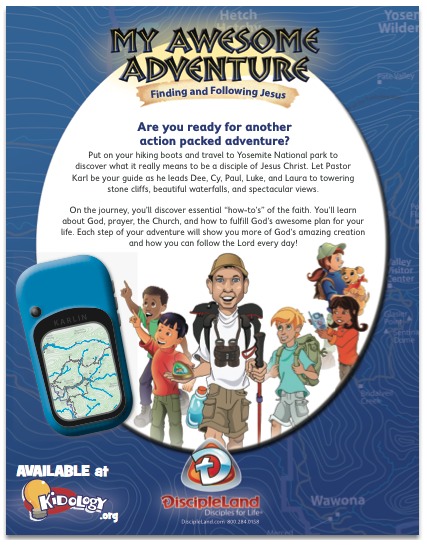
If you want to be a discipler of children, it is no secret that I recommend DiscipleLand if you are a church leader and would be delighted if you used Awesome Adventure as a tool for one on one studies, but the first thing you need is NOT curriculum - it is to build some relationships with kids that are deeper than the educational or “fun” level.

It may just be that some of your best disciples you never formally “discipled” through printed lessons - you just walked with them and became a part of their spiritual journey.

Whether you lead an entire children’s ministry with hundreds of children or teach a small class or volunteer in a club with a small group - pray through your kids and ASK GOD TO SHOW YOU A CHILD YOU CAN HAVE A DEEPER RELATIONSHIP WITH. And become their friend, not just their leader or teacher.

Jesus is my Master, my Lord, my Redeemer, my Savior, my Creator and my Guide, but best of all He is my Friend - and it is that relationship that spurs on my spiritual growth. Yoy may be many things to the kids in your ministry, but when you become their friend, you begin to truly impact their spiritual walk.

What does a friendship with a child look like?

  • You know their name
  • You know about their family
  • You have some common interests
  • You pray for them
  • You look for them
  • You ask them relational questions
  • You get together with them
  • You remember their important dates
  • You love them unconditionally

Take some time and think through the kids God has brought into your life - is there one or two that you could pour your life in to? A few you could become a friend to? That you could disciple intentionally? The impact on their life is indescribable!

GO FOR IT! What are you waiting for?

Curriculum: Your Ministry’s Foundation

While the word “curriculum” may solicit yawns from many people, don’t underestimate the importance of curriculum on your ministry! The foundation of your educational ministry is your curriculum. Everything else hinges from and is built upon the foundation laid by your educational hour teaching material. How high and how deep and how broad your educational ministry will be is greatly determined by curriculum.

HOW DO YOU CHOOSE CURRICULUM?

THE WRONG WAY:

  • Use what you have always used
  • Let your teachers each pick their own
  • Look at tons of samples and pickone based on what appeals to you
  • Depend on curriculum promotions
  • Use what some other great church uses

THE RIGHT WAY:

  • Determine what YOU would like to accomplish in your Sunday School educational program.
  • List your educational goals
  • List weaknesses with current material.
  • Make a list of what you are looking for.
  • THEN look at published materials that match your criteria.

I remember when I started my previous ministry, our curriculum situation was a mess! Here was what we were facing:

  • Every teacher used what they liked, over five published curriculums were in use, some taught without any published material.
  • Repetition and Omission of Bible stories was not only likely, but expected.
  • No idea what was accomplished in the years spent within the Children’s Ministry.
  • Lots of good ministry going on, but no way to know what was going to happen, or to evaluate results.

So what did we do? I called for a planning meeting and asked our teachers to determine what we wanted for our children. (without looking at a single curriculum sample!) Here is the list of what these godly and experienced teachers determined we wanted:

  • Gospel Oriented
  • A comprehensive overview of the entire Bible
  • Specific Goals and Objectives for Each Age
  • Progressive, and not Repetitive
  • Get children into the Word themselves
  • Emphasis on Scripture memory
  • High Quality Materials and Helpful Resources
  • One year cycle (meaning teachers teach the same thing every year)
  • Missions Focus
  • Flexibility for teaching styles and holidays
  • Tools to help parents engage in the process

THEN we hunted to see if any curriculum met ALL of these criteria.

Only one curriculum offered all the things above that our teachers wanted:

NOW IS THE TIME TO EVALUATE YOUR CURRICULUM. We used DiscipleLand long enough to see kids go entirely through the process and could see the results.

They have since added AMAZING on-line tools for kids and parents to further engage in the learning going on at church. You MUST check out DiscipleZone.com

FOR AN IN-DEPTH REPORT I WROTE ON DISCIPLELAND CHECK OUT THE KIDOLOGY SPOTLIGHT MINISTRY RESOURCE: DISCIPLELAND

If you haven’t done so already, NOW is the time to re-evaluate what you are using this fall in your educational ministry. Here is a quote we recently had posted in the forum discussion on DiscipleLand:

We ended up dividing our kids 6-9 and 10-12 and used DiscipleLand with the younger and it was amazing! The kids loved it, which is totally cool because it didn’t have any “high techy” stuff, but kept their undivided attention. I loved that during our review this past Wed the kids retained most everything! This is 2 thumbs up! Thank you Karl for introducing us to this. I would not hesitate to tell anyone to give this a try. They will be hooked.

For some VERY HELPFUL TOOLS for evaluating your ministry, be sure to see the evaluations available on the DiscipleLand Equipping Center. Every ministry ought to work through these tools WHETHER OR NOT they use DiscipleLand, or DiscipleLand will fit their ministry structure or needs.

Check out DiscipleLand, you’ll be glad you did! There is a reason more and more churches and switching to DiscipeLand!

What Happened to the Bible?

Jump over to DiscipleBlog.com where I posted a thought provoking article on what I am calling the Bibleless Trend in Children’s Ministry. I am certain if you teach children the Bible you will find it just might give you pause for consideration - or encourage you if you are not part of this rapidly growing trend that has rendered thousands of evangelical children’s ministries void of actual Bibles in children’s ministry!

Let me know our thoughts there on at this post. Go there now.

There is a great discussion on the post on Kidology.org Join the discussion!

How Can We Motivate Our Kids?

Here is an excellent post from the DiscipleLand newsletter:

dispatch.jpg

Many kids have lost interest in spiritual matters. They are discouraged about trying to please God. From their perspective, it is not “cool” to be godly. So they focus on their own desires and let the world guide them. The number one challenge in churches today is to overcome mediocrity. Christian kids are satisfied with lukewarm-ness.

To counteract this trend, some churches have replaced content-rich children’s ministries with high-energy programs. This may keep kids from being bored and it may eliminate the need to recruit volunteers, but it also severs teacher-learner relationships that foster discipleship. If we routinely motivate kids with flashy events, we are doomed to the “bigger and better” cycle. Each new program must offer more energy, excitement, and “wow” than the previous one.

Instead, we must move kids from extrinsic to intrinsic motivation. Throughout the Bible, God uses a variety of cause-effect techniques to motivate His people. Some are positive and some are punitive; some are earthly and some are eternal. Some are fascinating and some are frightening. Remind children that every human being will someday meet the Creator face-to-face-and give an account to Him.

Every child can be motivated-though not every child responds to the same stimulus. Find ways to lift your child’s eyes from self to God. Help him or her realize that our omnipresent God is both loving and just. Establish an appropriate system of rules and rewards. Reinforce attitudes and behaviors that honor God. Show how faith is relevant to life. Encourage, affirm, model, pray.

READ THE REST HERE plus download a FREE children’s devotional template!