

The Program Pyramid: Why Your Church Outreach Events Need a Strategy
Stop trying to accomplish everything with every event. Start moving people toward spiritual growth, one intentional step at a time.
- DOWNLOAD A PDF of this article: The Program Pyramid By Karl Bastian
Churches love events!
Easter egg hunts. Fall festivals. Vacation Bible School. Family fun nights. NERF Wars. Camps. After-school clubs. You name it, I’ve probably tried it, planned it, or at least dreamed about it!
After decades in children’s ministry, I’ve learned that the question isn’t simply, “What event should we do next?”
The better question is:
“Who are we trying to reach, and what do we want them to do next?”
Because here’s a mistake I see churches make all the time: They try to accomplish EVERYTHING with EVERY event.
They want an event that’s fun enough to attract unchurched families, biblical enough to disciple believers, and challenging enough to develop mature Christian leaders.
That’s a tall order for an Easter egg hunt!
The result is often an event that tries to do so many things that it doesn’t do any one thing particularly well.
Years ago, I developed a ministry planning strategy I call The Program Pyramid. It’s a simple framework that helps me plan events and programs intentionally, with a clear audience, purpose, and desired outcome.
And it’s one of the most valuable tools I’ve used in children’s ministry.
Introducing the Program Pyramid
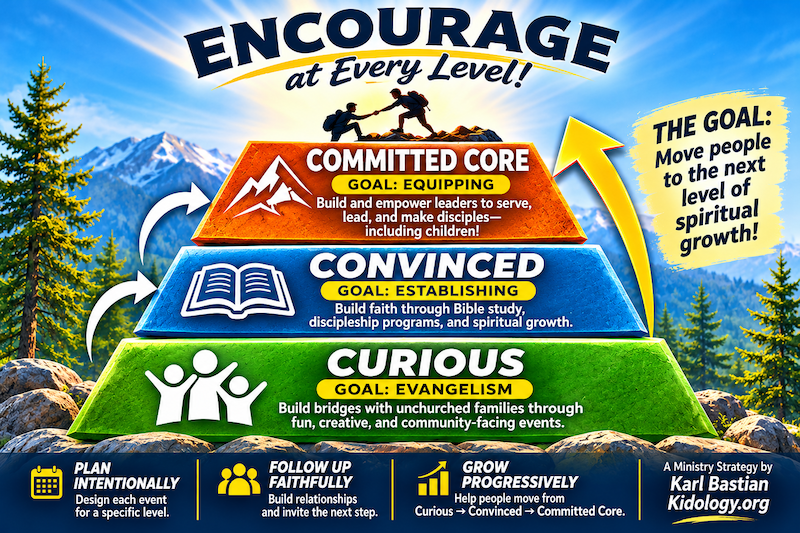
The Program Pyramid has three levels:
- CURIOUS — Goal: Evangelism
- CONVINCED — Goal: Establishing
- COMMITTED CORE — Goal: Equipping
Each level represents a different stage of connection and spiritual development. Each requires a different approach to ministry.
The objective isn’t simply to get people to attend more events. It’s to help them take their next step toward Jesus, spiritual maturity, and meaningful ministry.
Let’s look at each level.
LEVEL ONE: CURIOUS — Building Bridges
Primary Goal: EVANGELISM
The bottom of the pyramid is the widest because it represents the broadest audience: people in our communities who may have little or no connection to the church.
They may not know much about Christianity. They may have had negative experiences with church. They may simply have never considered attending.
But they have children. They enjoy having fun. They appreciate opportunities to connect with other families.
And THAT creates an opportunity!
Curious-level events are designed to remove barriers and build bridges.
Some of my favorite examples include:
- Paper Airplane Fairs: Creative, fun events that attract families through an activity nearly every child can enjoy.
- NERF Wars and Nachos: High-energy events that kids LOVE and naturally want to invite their friends to.
- Community Easter Egg Hunts: Family-friendly experiences that introduce the church to people who might never attend a traditional worship service.
- Neighborhood Outreach Events: Taking the fun directly into the community instead of expecting the community to come to us.
One of my favorite outreach approaches involved taking Easter egg hunts out into neighborhoods. Rather than hosting one giant event at the church, we distributed 50,000 eggs into neighborhoods where families could host hunts themselves.
We even brought the Easter Bunny and a magic show into the neighborhoods!
Why?
Because sometimes the biggest barrier to reaching an unchurched family is simply getting them to walk through the doors of a church.
So instead of waiting for them to come to us, we went to them!
But where’s the Bible teaching?
Here’s where some ministry leaders get nervous.
At a Curious-level event, I may not have a Bible lesson at all.
Sometimes an opening prayer might be as overtly spiritual as the entire event gets.
And I’m perfectly comfortable with that!
Why? Because I’m not trying to accomplish everything at this event.
I’m trying to build relationships, establish trust, create positive connections with the church, and open the door for future ministry.
That doesn’t mean I’m hiding my faith or avoiding opportunities to talk about Jesus. It means I’m being intentional about the purpose of the event.
If a family comes to our Paper Airplane Fair, has a fantastic time, meets some friendly Christians, and leaves thinking, “Wow, those church people are pretty nice!” — that’s a win!
The Gospel hasn’t been compromised. A bridge has been built.
And now we have an opportunity to invite that family to take another step.
The Curious-level goal is to move people from having no connection with the church to being willing to explore one.
LEVEL TWO: CONVINCED — Establishing Faith
Primary Goal: ESTABLISHING
The middle level of the pyramid is for children and families who have begun connecting with the church and are ready for something deeper.
They may be attending Sunday services. Their children may enjoy the kids ministry. They’re beginning to trust the church and are open to learning more about the Christian faith.
Now we can move beyond simply building bridges to intentionally establishing people in God’s Word.
Examples of Convinced-level ministries include:
- After-school Bible clubs
- Midweek discipleship programs
- Parent-child Bible studies
- Scripture memory programs
- Family discipleship courses
- Bible-centered camps and retreats
- Ongoing spiritual growth opportunities
At this level, biblical content becomes a central focus.
We’re teaching children how to read and understand their Bibles. We’re helping parents disciple their children. We’re encouraging prayer, worship, obedience, and spiritual disciplines.
We’re helping families move from enjoying church activities to developing a genuine relationship with Jesus.
And here’s an important distinction:
Attending church isn’t the same thing as growing spiritually.
A family can attend church events for years without ever developing a meaningful understanding of Scripture or taking ownership of their faith.
That’s why we need intentional programs designed specifically to establish people in the faith.
The goal isn’t just more attendance.
It’s spiritual growth.
LEVEL THREE: COMMITTED CORE — Equipping for Ministry
Primary Goal: EQUIPPING
At the top of the pyramid are those who are ready to move beyond receiving ministry into DOING ministry.
These are children, teenagers, parents, and adults who are ready to serve, lead, evangelize, and disciple others.
And yes, I absolutely include CHILDREN in this category!
One of my convictions is that children are not merely the church of tomorrow.
They are part of the church TODAY!
Children can serve. Children can lead. Children can share their faith. Children can pray for others. Children can make a meaningful difference in God’s Kingdom right now.
That’s why I love developing Kids Crew programs where children are trained and equipped to serve in ministry.
Depending on their age and abilities, children can help welcome others, participate in worship, assist with activities, serve alongside adult leaders, and learn practical ministry skills.
Imagine a child who grows up believing that church isn’t simply a place where adults entertain and teach them.
Instead, that child grows up understanding that God has gifted THEM to serve others!
We’re not just recruiting helpers.
We’re developing lifelong servants, evangelists, and disciple-makers.
The Committed Core level includes leadership training, mentoring, ministry teams, service opportunities, and intentional discipleship that prepares believers to invest in others.
This is where spiritual growth becomes spiritual multiplication.
And that’s the goal!
THE BIG MISTAKE: Trying to Do All Three Levels at Every Event
Here’s where the Program Pyramid becomes especially practical.
When I’m planning an event, I ask one question FIRST:
“Which level of the pyramid is this event designed to serve?”
Not after we’ve chosen the theme.
Not after we’ve designed the flyer.
Not after we’ve recruited volunteers.
BEFORE we do anything else!
Because the answer determines almost everything.
If it’s a CURIOUS event, I design it to be accessible, welcoming, fun, and easy for unchurched families to attend.
If it’s a CONVINCED event, I focus on biblical teaching, discipleship, and spiritual growth.
If it’s a COMMITTED CORE event, I focus on training, equipping, leadership, and opportunities to serve.
Now, can there be overlap? Of course!
A Curious event may create opportunities to share the Gospel. A Convinced event may include service opportunities. A Core event may be incredibly fun!
But those are secondary benefits.
Every event should have ONE primary purpose.
When we try to make every event accomplish everything, we often dilute its effectiveness.
A community outreach event doesn’t need to become a miniature Sunday morning service.
A discipleship class doesn’t need to be marketed like a carnival.
And a leadership training event doesn’t need to appeal to everyone in the community.
Different audiences. Different purposes. Different outcomes.
One overall mission.
THE MOST OVERLOOKED PART OF OUTREACH: FOLLOW-UP!
Now, if there’s one thing I’d love to shout from the rooftops to every children’s pastor, it’s this:
FOLLOW-UP IS MORE IMPORTANT THAN THE OUTREACH EVENT ITSELF!
I’ve watched churches spend thousands of dollars, hundreds of volunteer hours, and months of preparation on an incredible outreach event.
The decorations are amazing. The games are fantastic. The attendance is impressive.
Everyone goes home exhausted and happy.
And then…
Nothing.
No follow-up.
No personal contact.
No invitation to return.
No intentional next step.
What a missed opportunity!
Here’s my philosophy:
Plan your follow-up BEFORE you plan your event!
Before hosting an outreach, I want to know how we’re going to connect with the families who attend.
That might include:
- Emails: A friendly thank-you message with information about upcoming opportunities.
- Personal letters: A handwritten note can make a family feel genuinely valued.
- Text messages: A simple, timely invitation to an upcoming event or Sunday service.
- Phone calls: Personal contact that communicates, “We’re glad we met you!”
- Return incentives: A special drawing or contest the following Sunday that gives children a fun reason to return.
- Personal invitations: Volunteers and families intentionally inviting new friends to the next appropriate opportunity.
Of course, communication should always be respectful, welcomed, and appropriate. We want to build relationships, not bombard people with messages!
But the principle is simple:
The outreach event creates the introduction. The follow-up develops the relationship.
Sometimes I’ll even design a special contest where the drawing takes place the Sunday AFTER the outreach event.
Why?
Because the first visit is often the hardest.
Once a child returns and discovers that Sunday morning can be just as welcoming and exciting as the special event, the likelihood of building an ongoing connection increases.
The prize isn’t the real goal.
The relationship is.
And ultimately, the opportunity to share Jesus is what matters most.
An outreach event without follow-up may have been a wonderful community service.
But if our goal was to introduce people to the church and help them explore faith, we need to intentionally create opportunities for that relationship to continue.
THE SECRET: ALWAYS KNOW THE NEXT STEP
The Program Pyramid isn’t simply a way to categorize events.
It’s a way to create a pathway for spiritual growth.
Imagine a family who first connects with your church through a community NERF event.
They have a great time. Their children meet some new friends. They discover that church people aren’t nearly as boring as they expected!
Because you’ve planned your follow-up, they receive a friendly invitation to visit on Sunday.
They come.
Their kids love the children’s ministry.
Over time, the family becomes more connected with the church. The children begin attending a midweek Bible club. The parents participate in a family discipleship opportunity.
Eventually, those same children begin serving on a Kids Crew, helping welcome and minister to other children.
And one day, they’re inviting THEIR friends to the next community outreach!
Do you see what happened?
They moved from CURIOUS to CONVINCED to COMMITTED CORE.
And now they’re helping reach the next generation of curious families.
That’s spiritual multiplication!
Of course, real spiritual journeys aren’t always that neat or predictable. People grow at different rates, take different paths, and sometimes need to revisit earlier steps.
The pyramid isn’t meant to put people into rigid categories.
It’s meant to help ministry leaders intentionally create opportunities for people to grow.
ENCOURAGE AT EVERY LEVEL!
One feature of my original Program Pyramid illustration is the word ENCOURAGE arching over the entire pyramid.
That’s intentional.
At every level, our role is to encourage people toward their next step.
Encourage the curious family to explore.
Encourage the growing believer to dig deeper.
Encourage the committed Christian to step into ministry.
And encourage those already serving to keep growing, leading, and reaching others.
We don’t force spiritual growth. We create opportunities, provide guidance, build relationships, and trust God to work in people’s lives.
As Paul reminds us in 1 Corinthians 3, some plant and others water, but God is the One who gives the growth.
Our job is to be faithful with the opportunities He’s given us.
HOW TO PUT THE PROGRAM PYRAMID TO WORK
Here’s a practical exercise I’d encourage every children’s pastor or ministry leader to try.
Take your ministry calendar for the next twelve months.
Look at every major event and program you’ve scheduled.
Now ask:
1. Which level does this event primarily serve?
Curious? Convinced? Committed Core?
If you can’t clearly answer that question, you may need to reconsider the purpose of the event.
2. What is our primary desired outcome?
Are we trying to introduce unchurched families to the church?
Establish children in their faith?
Equip believers to serve?
Define success BEFORE the event.
3. What is the next step we’re inviting people to take?
Don’t wait until the event is over to figure this out.
Plan the invitation, the communication, and the follow-up strategy in advance.
4. Is our ministry calendar balanced?
Some churches have lots of Curious events but very little intentional discipleship.
Others have excellent Bible teaching but almost no opportunities for unchurched families to connect.
Still others have plenty of programs for children but very few opportunities for those children to serve.
A healthy ministry needs all three levels.
5. Are we measuring what really matters?
Attendance is helpful information, but it isn’t the ultimate measure of ministry effectiveness.
We should also be asking:
Are new relationships being formed?
Are families returning?
Are children growing in their understanding of Scripture?
Are people making decisions to follow Christ?
Are believers becoming equipped to serve?
Are children developing into leaders and disciple-makers?
Those are the outcomes worth celebrating!
FINAL THOUGHT: DON’T JUST PLAN EVENTS. PLAN A PATHWAY.
I love a great event.
Give me a room full of excited kids, some crazy games, a few hundred NERF darts, and a ridiculous costume, and I’m a happy children’s pastor!
But after all these years, I’ve learned that the greatest ministry impact doesn’t come from how spectacular an event is.
It comes from what happens NEXT.
It’s the relationships that begin.
The trust that’s established.
The conversations about Jesus that follow.
The children who grow in their faith.
And the young people who eventually become servants and leaders themselves.
So the next time you’re planning a ministry event, don’t start by asking, “What would be fun?”
Start by asking:
“Who are we trying to reach, where are they spiritually, and how can we help them take their next step?”
Then plan accordingly.
Because the goal isn’t simply to fill a calendar with events.
The goal is to develop disciples who make disciples.
And that’s a ministry strategy worth building on!
Karl Bastian is a veteran children’s pastor, ministry trainer, and founder of Kidology.org, dedicated to equipping and encouraging those who minister to children. His passion is helping churches reach children, disciple families, and develop the next generation of Christian leaders.